Why Does Spine Surgery Fail to Relieve Pain?
This is the question that matters most - and getting it right is the only way to determine the correct next step.
There is no single cause of FBSS. Each patient requires an individual diagnostic process. That said, the most common underlying reasons fall into several categories.
1. The Wrong Level Was Addressed
Imaging findings do not always correspond to clinical symptoms. A disc bulge visible on MRI at L4–L5 may not be the actual source of a patient's pain - yet it may appear most prominently on imaging and be selected for surgery. If the pain originated from a different spinal level, or from a structure not visualised, surgery on the wrong target will not help.
2. Incomplete Decompression
In decompression surgery (discectomy, laminectomy), the goal is to relieve pressure on nerves. If decompression is incomplete - if a fragment of disc, a bone spur, or scar tissue still compresses the nerve - the pain persists. This is particularly common in patients with significant spinal stenosis treated with limited decompression.
3. Failed Spinal Fusion (Pseudarthrosis)
Fusion surgery aims to permanently join two or more vertebrae. If the fusion does not take - a condition called pseudarthrosis - the segment remains mobile and painful. This is one of the most common causes of pain after fusion surgery and requires imaging and clinical assessment to confirm. Standard X-rays can miss pseudarthrosis; CT scans or dynamic imaging are often needed.
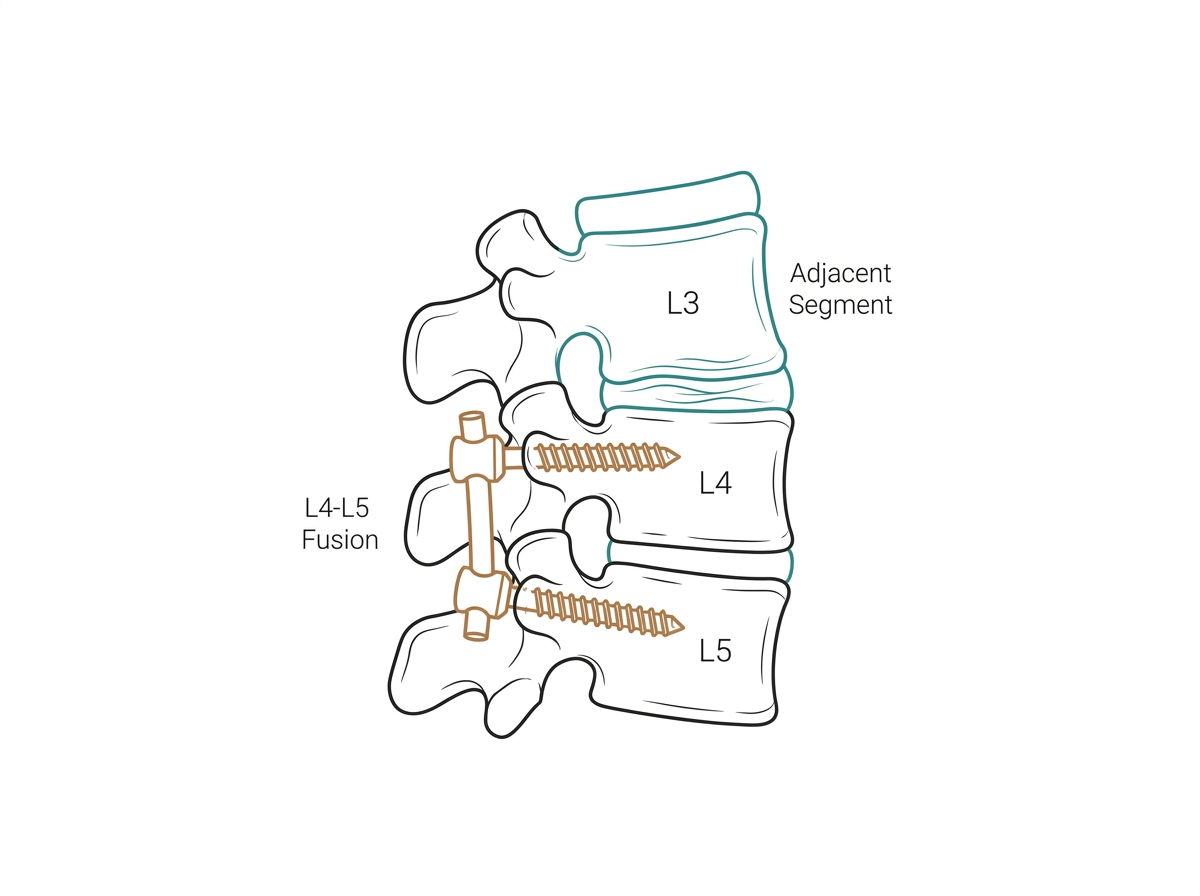
4. Adjacent Segment Disease
When one spinal segment is fused, the segments above and below it are exposed to additional mechanical stress. Over time - often years after the original surgery - these adjacent levels may develop accelerated degeneration, disc herniation, or stenosis. The pain returns, but from a different level. (Source: NIH/NLM - MedlinePlus, Spinal Fusion)
5. Epidural Fibrosis (Scar Tissue)
Every surgical procedure creates scar tissue. In the spine, scar tissue can form around the nerve roots (epidural fibrosis), tethering them and causing a different type of pain from the original nerve compression. Epidural fibrosis is one of the more difficult FBSS causes to treat because the scar tissue itself is not easily removable without creating more.
6. Hardware Failure or Migration
Screws, rods, cages, and other implants used in fusion surgery can break, loosen, or shift position. Hardware complications can cause localised pain, nerve irritation, or instability - and are identifiable on imaging.
7. The Wrong Diagnosis Before Surgery
This is perhaps the most important cause. If the source of pain was not accurately identified before surgery - if the operation addressed a radiological finding rather than a clinical pain generator - then surgery will not help regardless of how well it is executed. Facet joint pain, sacroiliac joint dysfunction, and referred pain from muscles or joints can mimic disc-related pain closely and can be misattributed on imaging alone.
The Core Principle
Successful spine surgery is not just about good surgical technique. It begins before the operation - with an accurate diagnosis of exactly what structure is causing the pain, confirmed through physical examination, imaging, and sometimes diagnostic injections. When that step is insufficient, even technically perfect surgery will not resolve the pain.
What Does Failed Back Surgery Syndrome Feel Like?
Patients with FBSS describe different pain experiences depending on the underlying cause. However, several patterns are commonly reported.
Persistent lower back pain that was present before surgery and has not changed after it - sometimes constant, sometimes activity-related. Leg pain (radiculopathy or sciatica) that continues or returns after an initial period of apparent improvement. Numbness or tingling in the legs or feet that was not fully resolved by surgery. New pain patterns at a different level or on the opposite side from the original symptoms. Pain that changes with position - worse when sitting, better lying flat, or vice versa - suggesting different structural sources.
Some patients also report a phenomenon that is clinically important: initial improvement after surgery, followed by gradual return of symptoms over weeks or months. This pattern is particularly associated with recurrent disc herniation, epidural fibrosis formation, or the onset of adjacent segment disease.
If any of these patterns match your experience, the pain you are living with has a cause. It is not in your head. It is not simply anxiety. And it is not something you must simply accept as your new normal.
When Should You Seek a Formal Re-Evaluation?
This is one of the most common questions I receive from patients who contact me after prior surgery elsewhere. The answer is clearer than many expect.
Seek a re-evaluation if:
- Your pain has continued beyond 3 months after surgery with no meaningful improvement
- Your pain improved initially and has now returned or worsened
- You are experiencing new symptoms - a different pain location, new numbness, or new weakness - that were not present before surgery
- You have been told to "wait and see" for more than 6 months with no structured diagnostic plan
- You have had more than one spine surgery and are still in significant pain
- Your quality of life - your ability to work, sleep, walk, or care for yourself - remains severely impacted by pain
A structured re-evaluation is not about criticising your previous surgeon. It is about getting a fresh, independent assessment of what is actually causing your pain today - so you can make an informed decision about what comes next.
This is not a time problem. It is an evaluation problem.
How Is Failed Back Surgery Syndrome Properly Evaluated?
A proper FBSS evaluation is not a quick consultation. It is a structured diagnostic process that considers the full picture - not just the most recent scan.
Step 1: Full Clinical History
The evaluation begins with understanding the complete timeline: the original pain, the diagnosis that led to surgery, what the surgery involved, what happened in recovery, when symptoms changed, and what the pain pattern is today. Small details in this history often reveal diagnostic clues that imaging misses.
Step 2: Review of All Prior Records
Operative reports, prior imaging, discharge summaries, and physiotherapy notes are all reviewed. We need to understand exactly what was done - not just what was planned - and what has changed since. I ask patients to bring everything they have.
Step 3: Updated Imaging
A new MRI is almost always necessary. Post-surgical anatomy is different from pre-surgical anatomy, and the radiological criteria for interpreting it are also different. Scar tissue versus recurrent disc herniation, for example, can appear similar on standard MRI but require different management. Dynamic X-rays assess for instability. CT is often necessary to evaluate fusion status where pseudarthrosis is suspected.
Step 4: Neurophysiological Assessment
Nerve conduction studies and electromyography can clarify whether nerve root damage from the original compression has healed, is ongoing, or has been worsened. This guides both prognosis and treatment decisions.
Step 5: Diagnostic Injections (Where Indicated)
In selected cases, targeted injections - into the facet joints, sacroiliac joint, or epidural space - serve both a diagnostic and therapeutic purpose. Temporary pain relief from a specific injection helps confirm the pain source, guiding the subsequent management plan.
Step 6: Honest Assessment of Options
Once the evaluation is complete, the findings are reviewed with the patient in plain language. Not every FBSS patient requires revision surgery. Some will benefit from injections, nerve pain medication, or neuromodulation. Others will benefit from targeted revision. And some will have pain that is currently at its limit of what surgery can address - and deserve to know that honestly rather than be offered another procedure with unrealistic expectations.
What Are the Treatment Options for FBSS?
Treatment for Failed Back Surgery Syndrome is determined by its cause. There is no universal protocol - each case requires an individualised plan based on the diagnostic findings.
Non-Surgical Management
Nerve pain medication (such as pregabalin or duloxetine) targets neuropathic pain - the burning, electric, or shooting pain caused by nerve irritation. Epidural steroid injections can reduce inflammation around nerve roots and provide significant short- to medium-term relief, particularly in patients with fibrosis or residual inflammation. Spinal cord stimulation (neuromodulation) is a proven intervention for selected FBSS patients - it modifies pain signals at the spinal cord level and has good long-term evidence for FBSS-associated neuropathic leg pain. Structured physiotherapy focused on spinal stability, postural correction, and graduated loading can help where the pain has a mechanical component.
Surgical Management
Revision surgery is appropriate when a specific, correctable structural cause of the pain has been identified - pseudarthrosis, hardware failure, recurrent disc herniation, adjacent segment disease, or inadequate decompression. The key word is specific. Revision surgery performed without a clear diagnosis of what it is trying to correct has poor outcomes.
For patients who need revision surgery, the evaluation described above is the preparation - and the planning - that makes it worthwhile. Learn more about what revision spine surgery involves and when it is indicated.
For patients where ongoing nerve damage or centralised chronic pain has developed, the treatment plan extends beyond the structural and addresses the neural and central sensitisation dimension of the pain.
When Is Revision Surgery the Right Answer?
Revision surgery is not a last resort - but it is also not a first response. It is the right answer when three conditions are met:
- A specific structural cause has been identified - pseudarthrosis, hardware failure, adjacent level disease, recurrent herniation, or inadequate prior decompression - that corresponds to the pain pattern.
- Non-surgical options have been appropriately trialled or are unsuitable given the severity of the finding - for example, significant instability or progressive neurological deficit.
- Realistic expectations have been established - the patient understands what the surgery aims to correct, what the recovery involves, and that outcomes in revision cases are generally good but less predictable than first-time surgery.
When these conditions are met, revision surgery can be genuinely transformative. Patients who have lived with post-surgical pain for years - and who have a specific correctable cause - often achieve substantial and lasting relief.
The key difference between a successful revision and an unsuccessful one is almost always the quality of the evaluation that preceded it. The surgery is the last step, not the first.
What a Revision Spine Assessment Looks Like in Practice
At the first consultation, we spend time understanding your full story - not just your most recent scan. Prior surgical records are reviewed before the appointment. We discuss the findings, what is and isn't surgically correctable, and what the realistic options are. You leave with a clear explanation of your diagnosis and a structured plan - not a rushed decision.
Why a Second Opinion After Spine Surgery Is Not a Betrayal
Many patients who contact me after prior surgery hesitate. They worry that seeking a second opinion is an act of disloyalty to the surgeon who treated them. They have been made to feel, sometimes directly and sometimes subtly, that questioning their outcome is the same as blaming their doctor.
It is not.
A second opinion is your right as a patient. It is a clinically recognised and encouraged practice. It does not require you to believe your original surgeon was incompetent - most FBSS cases arise from the complexity of the diagnosis, not from surgical error. Spine is complicated. Pain generators are not always identifiable before the first surgery. That is not a failure of skill; it is a limitation of diagnosis.
But if you are still in pain, you deserve a clear explanation of why. You deserve a structured re-evaluation - not a re-assurance.
Second opinion consultations for patients who have had prior spine surgery - anywhere in India - are a formal part of the practice. Prior records, imaging, and operative reports are reviewed before the appointment so the consultation begins with context, not from scratch.
If you are not sure whether what you are experiencing qualifies, get in touch. That question is worth asking.
Frequently Asked Questions About Failed Back Surgery Syndrome
What is Failed Back Surgery Syndrome (FBSS)?
Failed Back Surgery Syndrome (FBSS) is the medical term for persistent or recurring pain in the back or legs after spine surgery, where the expected pain relief was not achieved. It does not necessarily mean the surgery was technically performed incorrectly - it means that the operation did not resolve the underlying pain problem. FBSS is a recognised clinical diagnosis that requires structured evaluation, not dismissal.
How long is it normal to have pain after spine surgery?
Some post-operative pain is expected for 4 to 12 weeks as the body heals. Pain that continues beyond 3 months - especially if it reflects the original pain pattern or introduces new symptoms like different-location pain, new numbness, or new weakness - warrants formal evaluation. Persistent post-surgical pain is not simply a time problem. It is an evaluation problem.
What causes Failed Back Surgery Syndrome?
FBSS has multiple possible causes: operating on the wrong spinal level, incomplete nerve decompression, failed spinal fusion (pseudarthrosis), adjacent segment disease, epidural scar tissue (fibrosis), hardware failure, or an inaccurate pre-surgical diagnosis where the true pain generator was not identified. Each case has its own specific cause - which is why a thorough diagnostic evaluation is essential before any treatment decision.
Can FBSS be treated without another operation?
Yes. Not every FBSS patient requires revision surgery. After a thorough evaluation, many patients are effectively managed with targeted epidural injections, nerve pain medication, spinal cord stimulation, or structured physiotherapy. The evaluation determines the appropriate path. Surgery is the right answer only when a specific, correctable structural cause is identified.
Is it too late to get a second opinion years after my spine surgery?
It is never too late. A structured second opinion after spine surgery is your right as a patient, regardless of how much time has passed. Even years after the original procedure, a thorough evaluation can identify the cause of ongoing pain and offer a clear, structured plan. Dr. Vignesh reviews prior surgical records, imaging, and clinical history from patients anywhere in India.
Where can I get a second opinion for pain after spine surgery in Chennai?
Dr. Vignesh Pushparaj at MGM Malar, Chennai, specialises in revision spine surgery and structured second opinions for patients with persistent pain following prior spine surgery. Second opinions are welcome from patients across India. Prior records are reviewed before the consultation to ensure the appointment is clinically productive from the first moment.
The Principle That Guides Every Revision Case
Pain after spine surgery is not a character flaw. It is not an unrealistic expectation. And in most cases, it is not simply a matter of waiting longer.
The question worth asking is not "why is this taking so long?" The question is: "Has anyone done a proper diagnostic evaluation of what is actually causing my pain right now?"
That is where every revision case begins - with a careful, structured look at the complete picture. Not a quick scan review. Not a new surgery booked on the assumption that more will help. A proper evaluation of what went wrong, why, and what can realistically be done about it.
If you are still in pain after spine surgery, that evaluation is what you deserve.