Disc Herniation
Conservative management first - structured physiotherapy, targeted injections, and time. Surgery only when truly needed, performed with precision. Understanding your disc problem is the first step to resolving it.
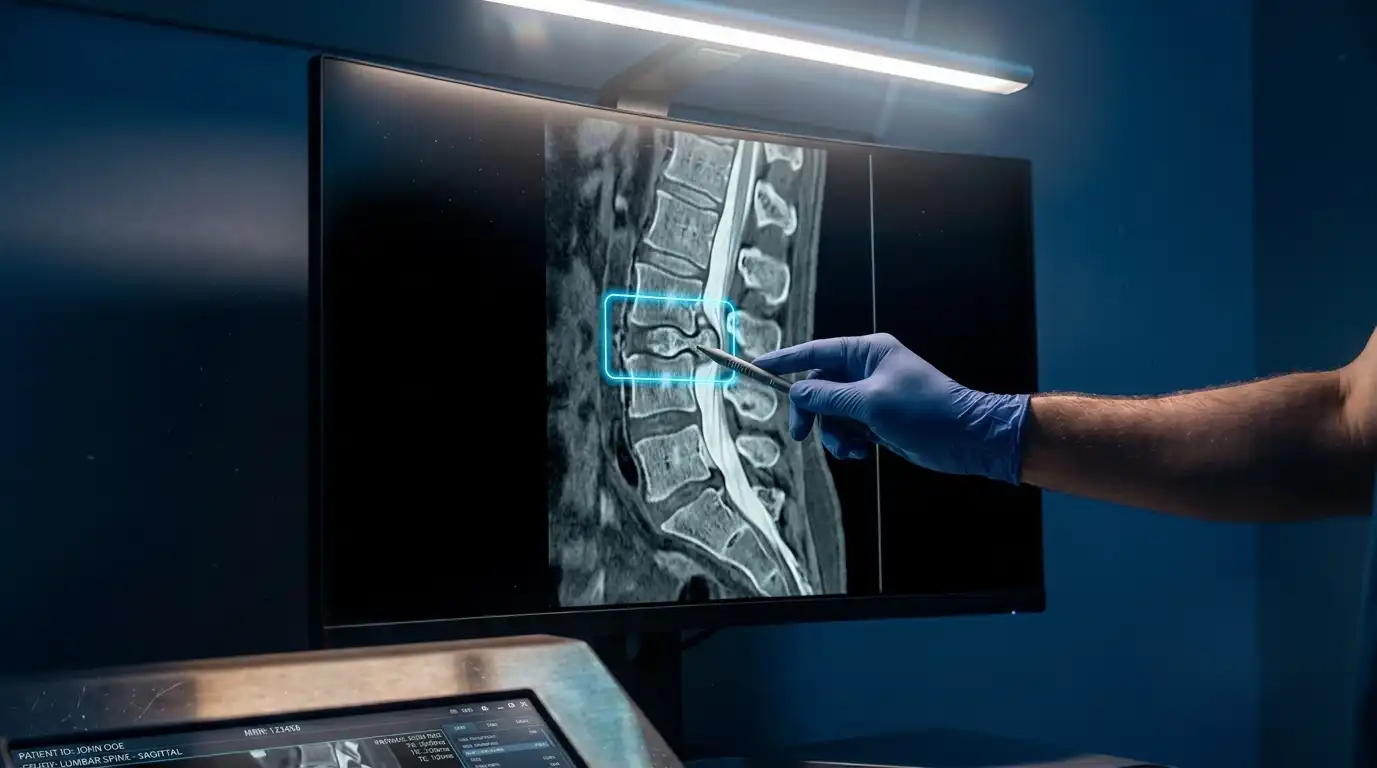
Intervertebral discs act as shock absorbers between vertebrae. Each disc has a tough outer ring (annulus fibrosus) and a gel-like centre (nucleus pulposus). When the annulus develops a tear - from injury, repetitive strain, or age-related degeneration - the nucleus can bulge or extrude through it.
The herniated material presses on nearby nerve roots, causing the characteristic pattern of pain, numbness, tingling, or weakness that radiates from the spine into the arm (cervical herniation) or leg (lumbar herniation - sciatica).
The good news: the immune system actively reabsorbs herniated disc material over weeks to months. Most herniations improve significantly with proper conservative care and time.
Lumbar (Low Back) Herniation
Cervical (Neck) Herniation
While most disc herniations can wait for a scheduled appointment, the following symptoms require urgent evaluation - they may indicate cauda equina syndrome, a surgical emergency:
If you have these symptoms, go to the nearest emergency department immediately or call us for urgent triage.
Contact for Urgent TriageFor selected patients, endoscopic discectomy - performed through a 7mm working channel - achieves equivalent nerve decompression with even less tissue disruption, faster return to activity, and the option of local anaesthesia in specific cases.
For cervical disc herniation causing arm pain or myelopathy, anterior cervical discectomy and fusion (ACDF) or cervical disc arthroplasty (motion-preserving) are available depending on the level, anatomy, and severity.
The right technique is chosen based on your specific anatomy and disease - not one-size-fits-all preference.
Relative rest (not bed rest), anti-inflammatory medications, and nerve-settling agents (gabapentin, pregabalin) for the acute phase. Walking and gentle movement are encouraged from day one.
Directional preference exercises (McKenzie method), core stabilisation, and neural mobilisation. Physiotherapy is the backbone of disc herniation recovery and reduces recurrence risk.
If symptoms persist beyond 4–6 weeks, a fluoroscopy-guided transforaminal epidural steroid injection (TFESI) delivers anti-inflammatory medication directly to the compressed nerve root - accelerating recovery and reducing surgical need.
Indicated when: symptoms persist beyond 6–12 weeks despite conservative care; progressive neurological deficit; cauda equina syndrome (emergency). The standard approach - a 2–3 cm incision, microscope-assisted nerve decompression - reliably resolves leg/arm pain from disc compression.
"My MRI shows a bulging disc - I must need surgery."
MRI findings do not dictate treatment - symptoms do. Disc bulges are found on MRI in over 50% of asymptomatic people over 40. Only a symptomatic disc causing significant functional impairment warrants treatment beyond conservative care.
"Bed rest is the best treatment."
Prolonged bed rest is harmful. It deconditions muscles, increases pain sensitisation, and prolongs recovery. Gentle movement, walking, and structured exercise accelerate healing.
"Surgery will definitely make my back worse."
Microdiscectomy for a properly selected patient - with ongoing leg pain from confirmed disc compression - has a success rate exceeding 85%. The risk of worsening from appropriately indicated surgery is low.
"Once you have a disc problem, you'll always have it."
Most acute disc herniations resolve completely. With proper rehabilitation and lifestyle changes (core strengthening, posture correction, weight management), recurrence rates are low and long-term outcomes are excellent.
Watch
Dr. Vignesh Pushparaj on why the vast majority of disc herniations resolve without surgery, and what actually determines the right treatment path.
Most disc herniations can be managed without surgery. Come in for a proper assessment and let us put together the right plan - conservative, interventional, or surgical - based on your specific situation.