
A 34-year-old software engineer came to see me after four months of what he described as "a weird tingling" in his thumb and index finger. He had already seen a hand specialist, tried a wrist splint at night, and cut back on typing. None of it helped. It was only when he mentioned, almost as an afterthought, that his neck had been stiff for longer than he could remember, that the actual picture came into focus.
His hand was not the problem. His neck was.
This mix-up is common, and understandable. When a nerve in the neck is compressed or irritated, the symptoms it produces often do not show up where the problem actually is. They show up further down the line, in the shoulder, the arm, the hand, sometimes in just one or two fingers. Patients chase the symptom. The source goes unexamined.
This is called cervical radiculopathy, and this article explains what it is, why the arm and hand are so often where it is felt, why it gets missed or misdiagnosed, and what a proper evaluation actually looks like.
What This Article Covers
- What Is Cervical Radiculopathy?
- Why Neck Problems Show Up as Arm or Hand Symptoms
- Why This Gets Mistaken for Something Else
- A Patient Case: When the Hand Wasn't the Problem
- When Arm Numbness Needs Urgent Attention
- How Cervical Radiculopathy Is Properly Diagnosed
- What Are the Treatment Options?
- When Is Surgery Actually Necessary?
- Why Combined Orthopedic and Neuro-Anatomical Training Matters Here
- Frequently Asked Questions
What Is Cervical Radiculopathy?
Cervical radiculopathy is the medical term for a pinched or irritated nerve root in the neck, at the point where it exits the cervical spine. Each nerve root in the neck supplies sensation and muscle strength to a specific area of the shoulder, arm, or hand. When one of these nerve roots is compressed, most commonly by a herniated disc or a bone spur pressing into the space it passes through, the result is pain, numbness, tingling, or weakness anywhere along that nerve's path.
This is different from neck pain caused by muscle strain or general stiffness. Cervical radiculopathy has a specific, identifiable cause, and it typically produces symptoms that extend beyond the neck itself.
Cervical Radiculopathy At a Glance
- A nerve root in the neck is compressed or irritated, usually by a disc or bone spur
- Symptoms often appear in the shoulder, arm, hand, or specific fingers, not just the neck
- The distribution of numbness or tingling usually follows a specific nerve pattern
- It is frequently misattributed to the arm or hand alone
- Most cases improve without surgery when properly diagnosed and managed
Why Neck Problems Show Up as Arm or Hand Symptoms
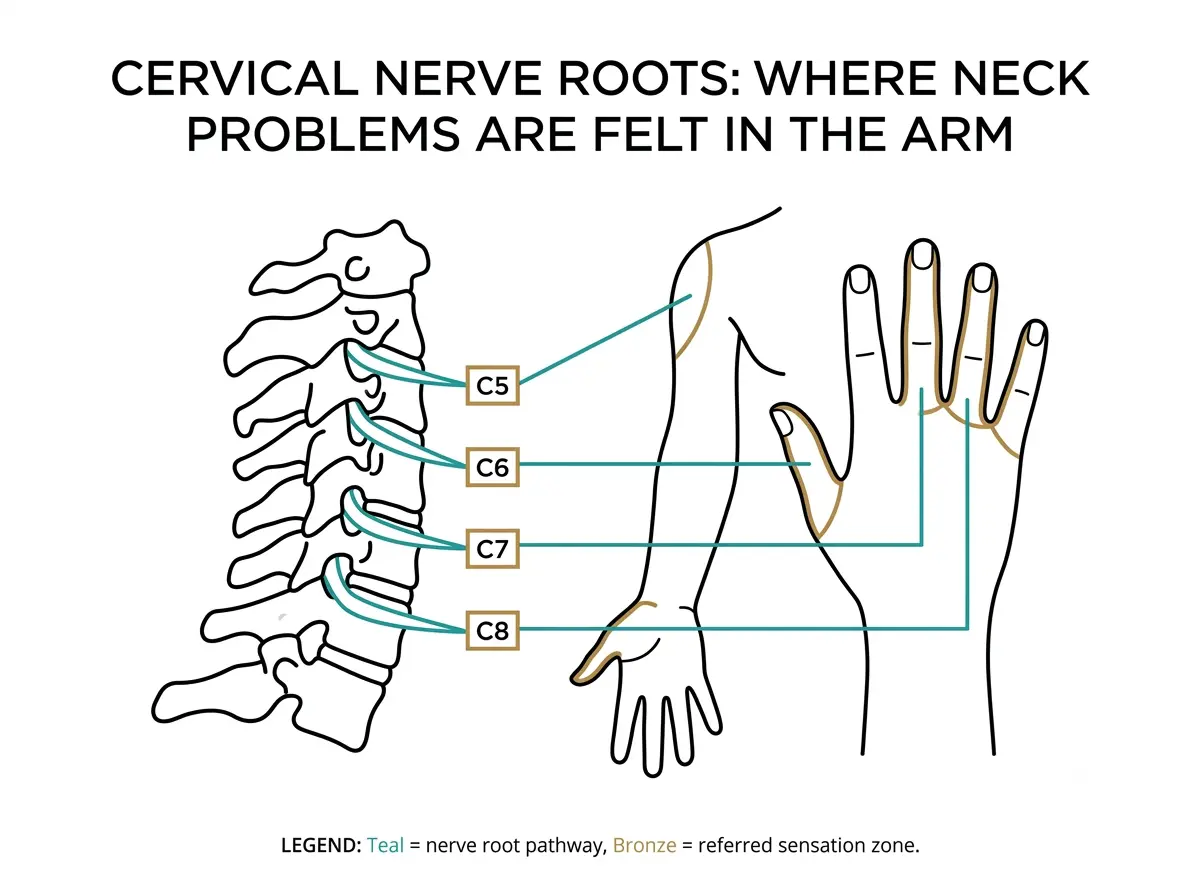
The nerves that control sensation and movement in your shoulder, arm, and hand all originate in the cervical spine. They exit the spine between specific vertebrae and travel outward, branching into the areas they supply. When a nerve root is compressed at its origin in the neck, the disruption is carried along the entire length of that nerve, which is why the symptom is frequently felt far from where the compression is actually happening.
This explains why a problem at, for example, the C6 nerve root in the neck can produce numbness specifically in the thumb and index finger, while a problem at C7 might affect the middle finger, and a problem at C8 the ring and little fingers. Each level has a fairly consistent pattern. (Source: NIH/NLM - MedlinePlus, Cervical Radiculopathy)
Understanding this pattern is exactly what allows an examiner to work backward from the symptom to the source, testing specific reflexes, strength, and sensation zones to identify which nerve root, and therefore which level in the neck, is involved.
Why This Gets Mistaken for Something Else
Cervical radiculopathy is missed or misdiagnosed more often than it should be, for a few consistent reasons.
The Symptom Is Far From the Cause
When the hand or arm is where the discomfort is felt, that is naturally where attention goes first. Patients see hand specialists. They rest their wrists. They try splints. If the neck is stiff but not painful in an obvious way, it rarely comes up in the conversation until specifically asked about.
It Mimics Carpal Tunnel Syndrome
Numbness and tingling in the hand, especially in the thumb and first two fingers, is also the hallmark of carpal tunnel syndrome, a compression of the median nerve at the wrist. The two conditions can look similar at first glance, but they usually behave differently. Carpal tunnel symptoms are often worse at night and with wrist positions like holding a phone or steering a car. Cervical radiculopathy symptoms often change with neck position, and frequently come with neck stiffness or pain that carpal tunnel does not produce on its own.
It Gets Labelled "Just a Nerve" or a Gym Injury
Because the arm symptom can come on gradually, it is often attributed to overuse, a workout, or sleeping in an awkward position. These explanations feel reasonable and are sometimes accurate. But when the numbness or tingling persists for weeks, recurs, or is accompanied by any neck stiffness, it deserves a proper look rather than an assumption.
Desk Posture Gets Blamed Instead of Examined
In an era of long hours at a desk or looking down at a phone, poor posture is a common and convenient explanation for neck-related symptoms. Posture can certainly contribute to neck strain. It is a much less satisfying explanation once numbness, tingling, or weakness travels into the arm or hand, at which point it deserves examination rather than a reminder to sit up straighter.
The Core Principle
Treating the arm without examining the neck treats the messenger, not the message. If arm or hand symptoms come with any neck stiffness, or do not resolve with the usual wrist-focused measures, the neck deserves to be examined specifically, not assumed to be unrelated.
A Patient Case: When the Hand Wasn't the Problem
Returning to the engineer from the opening of this article: by the time he came in, he had already been managing his symptoms as a hand problem for four months. A wrist splint. Reduced typing. A wait-and-see approach that had not produced any real change.
On examination, his wrist tests for carpal tunnel syndrome were unremarkable. But specific neck movements reproduced the tingling in his thumb and index finger within seconds, a finding that pointed strongly toward the C6 nerve root rather than the wrist. An MRI of his cervical spine confirmed a disc herniation at the C5-C6 level, pressing directly on that nerve root.
He did not need surgery. With a structured course of physiotherapy, targeted anti-inflammatory treatment, and activity modification, his symptoms resolved substantially over eight weeks. What made the difference was not an aggressive intervention. It was identifying the actual source, four months after it started, instead of continuing to treat a symptom that was never going to respond because it was never the true problem.
Cases like this are not unusual. What made this one take four months to resolve was not the severity of the underlying problem. It was the time spent looking in the wrong place.
When Arm Numbness or Tingling Needs Urgent Attention
Most cases of cervical radiculopathy are not medical emergencies, and most improve with conservative treatment. But certain patterns should prompt a faster evaluation rather than a wait-and-see approach.
Seek evaluation without delay if you notice:
- Progressive weakness in the arm or hand, especially if it is getting worse rather than staying steady
- Numbness or tingling in both arms at the same time, rather than one side
- Symptoms in the legs, changes in walking or balance, or clumsiness with fine hand movements such as buttoning a shirt
- Loss of bladder or bowel control, which is rare but requires emergency evaluation
- Severe neck pain following an injury, a fall, or an accident
These patterns can indicate involvement of the spinal cord itself rather than a single nerve root, a distinction that changes both the urgency and the treatment approach. This is uncommon, but it is exactly why arm or hand symptoms with a neck component deserve a proper clinical examination rather than a home remedy.
How Cervical Radiculopathy Is Properly Diagnosed
Step 1: A Detailed History
When did the symptoms start? Did neck pain come first, or the arm symptom? What makes it better or worse? Does it change with neck position, looking up, looking down, turning the head? These details, more than any single test, usually point toward the diagnosis before imaging is even reviewed.
Step 2: A Focused Physical Examination
Reflexes, strength, and sensation are tested in patterns specific to each cervical nerve root. Certain neck movements or positions that reproduce the arm symptom, a finding sometimes called a positive Spurling's test, help confirm that the neck is the source rather than the wrist or elbow.
Step 3: MRI of the Cervical Spine
Imaging confirms which level is involved and what is causing the compression, typically a herniated disc or a bone spur from degenerative changes. Imaging is interpreted alongside the clinical findings, not in isolation, since minor disc changes are common on MRI even in people without any symptoms.
Step 4: Nerve Conduction Studies (Where Needed)
When the clinical picture is unclear, or to help distinguish cervical radiculopathy from a peripheral nerve problem such as carpal tunnel syndrome, nerve conduction studies and EMG can clarify exactly where along the nerve's path the problem lies.
The point of a thorough evaluation is not to run every possible test. It is to confirm, with reasonable confidence, exactly which nerve root is involved and why, so that treatment is targeted rather than a guess.
What Are the Treatment Options?
The large majority of cervical radiculopathy cases improve without surgery. Treatment is generally staged, starting conservative and escalating only if needed.
Non-Surgical Management
Activity modification reduces positions and movements that aggravate the nerve while healing occurs. Physiotherapy focused on cervical spine mechanics, posture, and gradual strengthening addresses both the immediate symptom and contributing factors. Anti-inflammatory medication or short-term nerve pain medication can reduce irritation and discomfort during the acute phase. Cervical epidural steroid injections can be considered for more persistent cases, delivering anti-inflammatory medication directly to the affected nerve root.
Most patients see meaningful improvement within six to twelve weeks of appropriate conservative treatment. Improvement is not always linear, but a genuine trial of non-surgical care is the right starting point for the great majority of cases.
Surgical Management
Surgery is reserved for a smaller group of patients: those with significant or progressive weakness, those whose symptoms have not improved despite an adequate trial of conservative treatment, or those with evidence of more significant nerve or spinal cord compression on imaging. When indicated, procedures such as a cervical discectomy, with or without fusion, or a posterior foraminotomy aim to directly relieve the pressure on the affected nerve root.
When Is Surgery Actually Necessary?
Surgery for cervical radiculopathy is appropriate when a specific combination of findings is present, not simply because symptoms have persisted for a while.
- A clear structural cause has been confirmed on imaging that corresponds to the nerve root producing the symptoms.
- Conservative treatment has been genuinely trialled for an adequate period, generally six weeks or more, without meaningful improvement, or there is significant weakness that cannot safely wait that long.
- The expected benefit clearly outweighs the risk, with the patient understanding what the procedure involves, what recovery looks like, and what outcome is realistic.
When these conditions are met, surgery for cervical radiculopathy has a strong track record, particularly for relieving arm pain and preventing further nerve damage from ongoing compression. The decision is never made from imaging alone. It is made from the full clinical picture.
Why Combined Orthopedic and Neuro-Anatomical Training Matters Here
Neck cases that present as arm or hand symptoms sit at a genuine intersection of two disciplines: the structural, orthopedic side of the spine, and the neurological pathways that run through it. A purely structural view can miss a nerve-level explanation for symptoms. A purely neurological view can miss a correctable mechanical cause sitting right on the nerve.
Assessing these cases with both lenses at once, rather than referring back and forth between specialities, is what allows a source like a specific disc level to be connected confidently to a specific symptom pattern in the hand, and a treatment plan to be built around that connection rather than around a general assumption.
This is the same combined approach applied across complex cervical spine and neck cases more broadly, from straightforward radiculopathy through to cervical myelopathy, deformity, and revision cases.
Frequently Asked Questions About Neck Pain with Arm Symptoms
Why does neck pain cause numbness or tingling in my arm or hand?
When a nerve root in the neck is irritated or compressed, typically by a herniated disc or bone spur, the pain, numbness, and tingling can travel along the path of that nerve into the shoulder, arm, hand, or fingers. This is called cervical radiculopathy. The arm symptom is often the messenger; the neck is where the problem actually originates.
Could this be carpal tunnel syndrome instead of a neck problem?
It can be difficult to tell the two apart without a proper examination, since both can cause numbness and tingling in the hand. Carpal tunnel syndrome usually affects the thumb, index, and middle fingers and is linked to wrist position and repetitive use. Cervical radiculopathy often includes neck pain, symptoms that change with neck movement, and a distribution pattern that follows a specific nerve root rather than the wrist. A clinical exam, and sometimes nerve conduction studies, can distinguish between the two.
Is cervical radiculopathy serious?
Most cases improve with non-surgical treatment such as physiotherapy, medication, and activity modification. It becomes more serious when there is progressive weakness in the arm or hand, symptoms in both arms, or signs affecting the legs or bladder, which can indicate spinal cord involvement and need urgent evaluation.
Do I need surgery for neck pain with arm numbness?
No, not in most cases. The majority of patients with cervical radiculopathy improve with conservative treatment within a few weeks to months. Surgery is considered when there is significant or worsening weakness, symptoms that have not improved after a genuine trial of conservative care, or evidence of spinal cord compression on imaging.
How is cervical radiculopathy diagnosed?
Diagnosis begins with a detailed history and a physical examination that tests reflexes, strength, and sensation along specific nerve root patterns. An MRI of the cervical spine confirms which disc or level is involved. Nerve conduction studies and EMG are sometimes used to clarify the diagnosis or rule out other causes such as carpal tunnel syndrome.
Where can I get a neck and arm pain evaluation in Chennai?
Dr. Vignesh Pushparaj at MGM Malar, Chennai, evaluates neck pain with arm or hand symptoms with combined orthopedic and neuro-anatomical assessment, and treats the full range of cervical spine conditions from straightforward cervical radiculopathy to complex cervical myelopathy and deformity.
The Question Worth Asking
If your hand or arm has been tingling, numb, or weak for weeks, and the usual explanations, a wrist splint, less typing, a change in sleeping position, have not made a real difference, the question worth asking is not "what's wrong with my hand?"
It is: "has anyone actually examined my neck?"
That single question, and a proper clinical examination to answer it, is often what separates months of treating the wrong thing from a clear diagnosis and a straightforward path back to normal.