
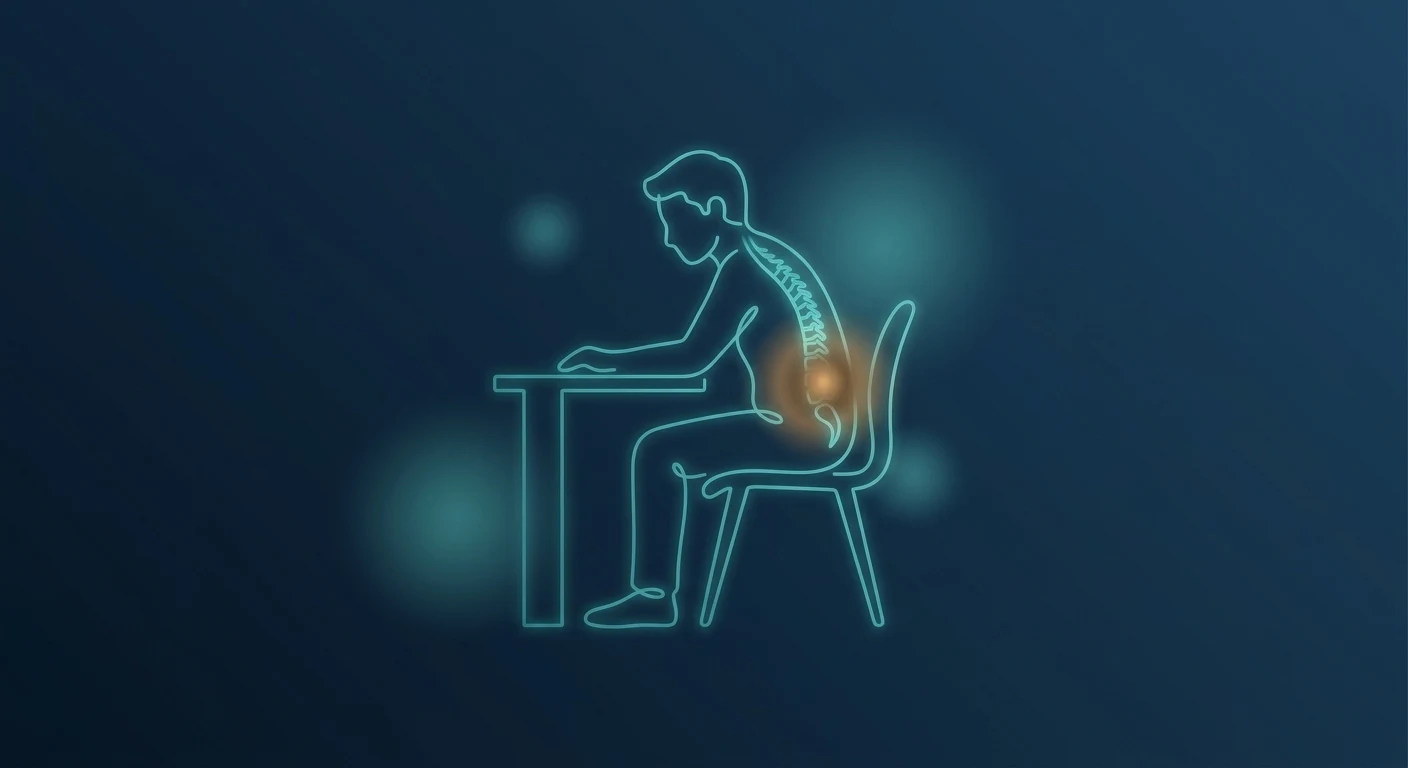
A 27-year-old came to see me with lower back pain that had been building for almost a year. He worked at a desk, ten to twelve hours a day, most of it in the same slouched position in front of two monitors. Every doctor he had seen before me had told him some version of the same thing: he was too young to worry, it was probably just posture, he should try yoga and stretch more.
He had tried all of it. The pain had not gone away. By the time he came to me, it had started travelling down his left leg.
His MRI showed a disc herniation at L4-L5, pressing on a nerve root. Not a posture problem. A structural one, and one that had likely been building for a long time before the pain became impossible to ignore.
This is a pattern I see often enough that it deserves its own explanation: spine problems are showing up earlier than most people, including some doctors, expect, and prolonged sitting is one of the biggest reasons why.
What This Article Covers
- The "Too Young for This" Myth
- Why Spine Problems Are Starting Earlier
- The Desk Job Connection
- Why Younger Patients Get Dismissed
- A Patient Case: Twenty-Seven and Not "Just Posture"
- When Young-Adult Back Pain Needs a Proper Look
- How It Is Properly Evaluated
- What Are the Treatment Options?
- Prevention for Desk Workers
- Frequently Asked Questions
The "Too Young for This" Myth
There is a common assumption, held by patients and unfortunately by some doctors too, that spine degeneration and disc problems are conditions of middle age and beyond. Under this assumption, a 27-year-old with back pain is more likely to be told to stretch and relax than to be sent for imaging.
This assumption is not supported by what is actually seen in clinical practice. Disc degeneration is, at its core, a wear-related process, and wear is a function of mechanical load and time, not a birthday. A spine subjected to years of poor mechanical loading, prolonged sitting, minimal core support, low activity levels, can show wear patterns typically associated with much older age.
The Myth vs. The Reality
- Myth: Spine problems only happen after 40 or 50
- Reality: Disc degeneration is driven by mechanical load and lifestyle, not age alone
- Myth: Back pain in your 20s or 30s is always posture or stress
- Reality: Posture can contribute, but persistent or radiating pain needs a structural explanation
- Myth: Young age means you can skip proper evaluation
- Reality: Age is not a diagnostic test; symptoms and examination findings are
Why Spine Problems Are Starting Earlier
Several factors, layered together, explain why spine issues are appearing in younger patients more than they used to.
Sedentary lifestyle means far less overall movement across a typical day than in previous generations, with commuting, work, and leisure time increasingly spent sitting. Reduced core and back muscle strength from inactivity removes a layer of natural support that would otherwise offload pressure from the spine. Prolonged, uninterrupted sitting, often for hours without a break, keeps the lumbar discs under sustained pressure in a way the spine is not designed to tolerate for that long. Screen-driven posture, leaning toward a monitor or looking down at a phone, adds additional mechanical strain to the neck and lower back beyond simply sitting.
None of these factors alone is dramatic. Combined and sustained over years, they add up to measurable, earlier wear on the spine, which is exactly what shows up on imaging in patients far younger than the textbook expectation. (Source: NIH/NLM - MedlinePlus, Herniated Disc)
The Desk Job Connection
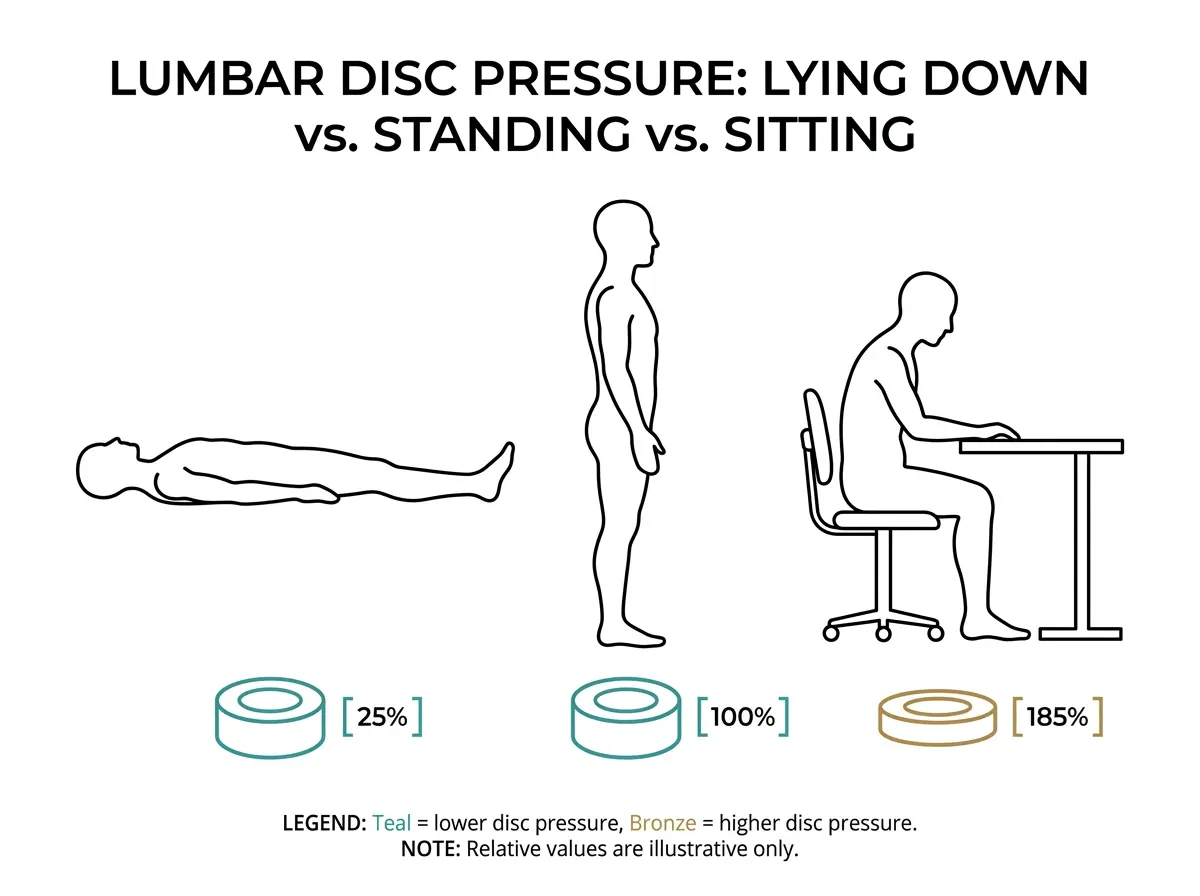
Sitting places significantly more pressure on the lumbar discs than standing does, and considerably more than lying down. A forward-leaning, slouched sitting posture, common during long stretches of focused desk work, increases that pressure further still.
For someone sitting eight, ten, or twelve hours a day, most of it in a single posture with infrequent breaks, this is not an occasional strain. It is a sustained daily load on the same structures, day after day, year after year. Over time, this contributes to accelerated disc wear, reduced disc hydration, and a lower threshold for a disc bulge or herniation to become symptomatic.
This does not mean every desk worker will develop a disc problem, and it is not a reason to panic about a job that cannot simply be changed. It is a reason to take early back pain seriously rather than assuming it is unrelated to age or "just how work is."
Why Younger Patients Get Dismissed
Beyond the general assumption that spine problems belong to older age, there are a few specific reasons younger patients with back pain are often sent away with a posture lecture rather than a proper evaluation.
Statistical Bias in Clinical Judgement
Doctors, like anyone, are influenced by what is common. Because disc problems are statistically more frequent in older patients, a younger patient presenting with the same symptoms can be mentally filed under a lower-probability, lower-concern category before an examination has even ruled anything in or out.
"Fix Your Posture" Is an Easy, Reasonable-Sounding Answer
Posture correction is genuinely good general advice, low risk, and often somewhat helpful. That makes it a comfortable default recommendation, one that does not require imaging, referral, or further workup, even when it does not fully address what is actually happening.
Young Patients Often Under-Report Severity
Younger patients, especially those otherwise fit and active, sometimes minimise their own symptoms, describing pain as manageable or assuming it will pass because they are "too young for it to be serious." That framing can carry into the consultation and shape how much workup gets pursued.
The Core Principle
Age can inform probability, but it should never replace examination. A thorough history and physical exam, not a birth year, is what determines whether back pain in a 27-year-old needs imaging and a structured plan, or genuinely just needs better posture and time.
A Patient Case: Twenty-Seven and Not "Just Posture"
The patient from the opening of this article had done everything reasonably expected of him. He had adjusted his desk setup. He had tried yoga. He had stretched daily for months. None of it resolved his pain, and by the time the pain began radiating down his leg with intermittent numbness, it was clear this was not simply a posture issue that had not yet responded to correction.
His MRI confirmed an L4-L5 disc herniation compressing the adjacent nerve root, consistent with the leg symptoms he had developed. This is a mechanical, structural finding, not a mood, stress, or fitness-level issue.
With a structured non-surgical program, targeted physiotherapy, activity and workstation modification, and a short course of anti-inflammatory treatment, his leg symptoms resolved within roughly ten weeks, and his back pain improved substantially alongside changes to how his workday was structured. He did not need surgery. He did need someone to look past his age and take the actual symptom pattern seriously.
When Young-Adult Back Pain Needs a Proper Look
Most back pain in young adults, including much of what is related to desk work, responds well to conservative measures. But certain patterns mean it is time to move beyond posture advice and get a structured evaluation.
- Pain lasting more than a few weeks despite rest, stretching, and posture correction
- Pain radiating into the leg, particularly below the knee, with or without numbness or tingling
- Any weakness in the leg or foot, such as difficulty lifting the front of the foot
- Pain that disrupts sleep or significantly limits daily activity or work
- Loss of bladder or bowel control, which is rare but requires emergency evaluation
If any of these apply, waiting longer in the hope that posture correction alone resolves it is not the right approach. A proper evaluation, not more time, is what is needed.
How It Is Properly Evaluated
Step 1: A Detailed History Including Lifestyle and Work Pattern
Understanding how many hours are spent sitting, what the workstation setup looks like, activity levels outside of work, and the exact pattern of the pain gives as much diagnostic information as many tests, and shapes what to look for on examination.
Step 2: A Focused Physical Examination
Range of motion, nerve tension tests, reflexes, strength, and sensation are assessed to determine whether the pain pattern is mechanical, nerve-related, or both, and to identify which spinal level is likely involved if a nerve is affected.
Step 3: Imaging Where Clinically Indicated
An MRI is not needed for every case of back pain, particularly early, non-radiating pain without red flag features. It becomes appropriate when pain persists beyond a reasonable conservative trial, when there is leg involvement, or when weakness is present, confirming or ruling out a structural cause such as a disc herniation.
Step 4: A Clear, Honest Explanation
Whatever the finding, the goal is a plain-language explanation of what is actually happening and why, rather than a generic instruction to be more careful with posture. Age should inform how a finding is interpreted, not whether it gets looked for in the first place.
What Are the Treatment Options?
Treatment for young-adult back pain, including disc-related back pain, is staged, and surgery is the exception rather than the starting point.
Non-Surgical Management
Structured physiotherapy targeting core strength, lumbar stability, and movement mechanics addresses both the current pain and the underlying contributing factors. Workstation and ergonomic changes, desk and chair height, monitor position, and scheduled movement breaks reduce the sustained load that contributed to the problem in the first place. Activity modification and graded return to movement avoids both complete rest, which can worsen deconditioning, and pushing through pain that has not yet been properly assessed. Anti-inflammatory medication or, in select cases, an epidural steroid injection can manage acute symptoms while the underlying program takes effect.
Surgical Management
Surgery is considered only when there is significant nerve compression with meaningful leg pain or weakness that has not responded to an adequate trial of conservative treatment, or in the rare case of a large disc herniation causing progressive neurological deficit. For most young patients, including those with a confirmed disc herniation, surgery is not the first or even the most likely path.
Learn more about how disc herniation is evaluated and treated, including when conservative care is genuinely sufficient.
Prevention for Desk Workers
For those without significant symptoms yet, or recovering from an episode of back pain, a few consistent habits meaningfully reduce the sustained load that contributes to early spine wear.
- Move every 30 to 45 minutes, even briefly, to break up sustained sitting pressure on the discs
- Set up the workstation properly, with the monitor at eye level and the chair supporting the natural curve of the lower back
- Build core and back strength through regular, structured exercise rather than occasional stretching alone
- Avoid prolonged forward-leaning posture toward screens, which adds strain beyond sitting itself
- Treat early, mild back pain as informative, not something to simply push through indefinitely
None of this guarantees a spine free of problems. It meaningfully shifts the odds, and it is a far better use of the "fix your posture" advice than as a substitute for evaluating pain that has already become persistent.
Frequently Asked Questions About Back Pain in Young Adults
Can you have a real spine problem in your 20s or 30s?
Yes. Disc degeneration and disc herniation are not conditions reserved for older age. Prolonged sitting, sedentary lifestyle, reduced core strength, and in some cases genetics can all contribute to spine problems appearing in young adults. Age alone does not rule out a structural cause for back pain.
Is my back pain just from bad posture?
Posture can be a contributing factor, but it is rarely the complete explanation, especially when pain is persistent, radiates into the leg, or does not improve with posture correction and stretching. Treating every case as a posture issue without examination risks missing an underlying disc or joint problem that needs a different approach.
Why does sitting all day cause back pain?
Prolonged sitting increases pressure on the lumbar discs compared to standing, particularly with a forward-leaning or slouched posture. Sustained over years, this added disc pressure, combined with weaker supporting core and back muscles from inactivity, can accelerate wear on the spine and contribute to earlier disc degeneration or herniation.
When should a young adult with back pain see a spine specialist?
A proper evaluation is warranted if back pain lasts more than a few weeks despite rest and activity modification, if pain radiates into the leg with numbness or tingling, if there is any weakness, or if pain significantly limits daily activity or sleep. Waiting extended periods hoping it resolves on its own is not necessary once these signs are present.
Does back pain in young adults always need surgery?
No. The large majority of young adults with back pain, including many with disc herniation, improve with conservative treatment such as physiotherapy, core strengthening, ergonomic changes, and activity modification. Surgery is considered only for a small subset with significant nerve compression, progressive weakness, or symptoms that do not respond to an adequate trial of conservative care.
Where can a young professional get a spine evaluation in Chennai?
Dr. Vignesh Pushparaj at MGM Malar, Chennai, evaluates back pain in patients of all ages, including young professionals with desk-job-related spine issues, with a structured diagnostic approach rather than a default posture explanation.
The Question Worth Asking
If you are in your 20s or 30s and have been told you're too young for a real spine problem, the question worth asking is not "am I overreacting?"
It is: "has anyone actually examined this properly, or was age the only reason it was dismissed?"
Back pain that persists, radiates, or comes with any weakness deserves an answer based on examination, not an assumption based on your date of birth.