Revision Spine Surgery
Spine revision surgery demands a different level of expertise - navigating scar tissue, altered anatomy, failed hardware, and unresolved pathology. Dr. Vignesh Pushparaj specialises in finding what was missed and correcting it safely.
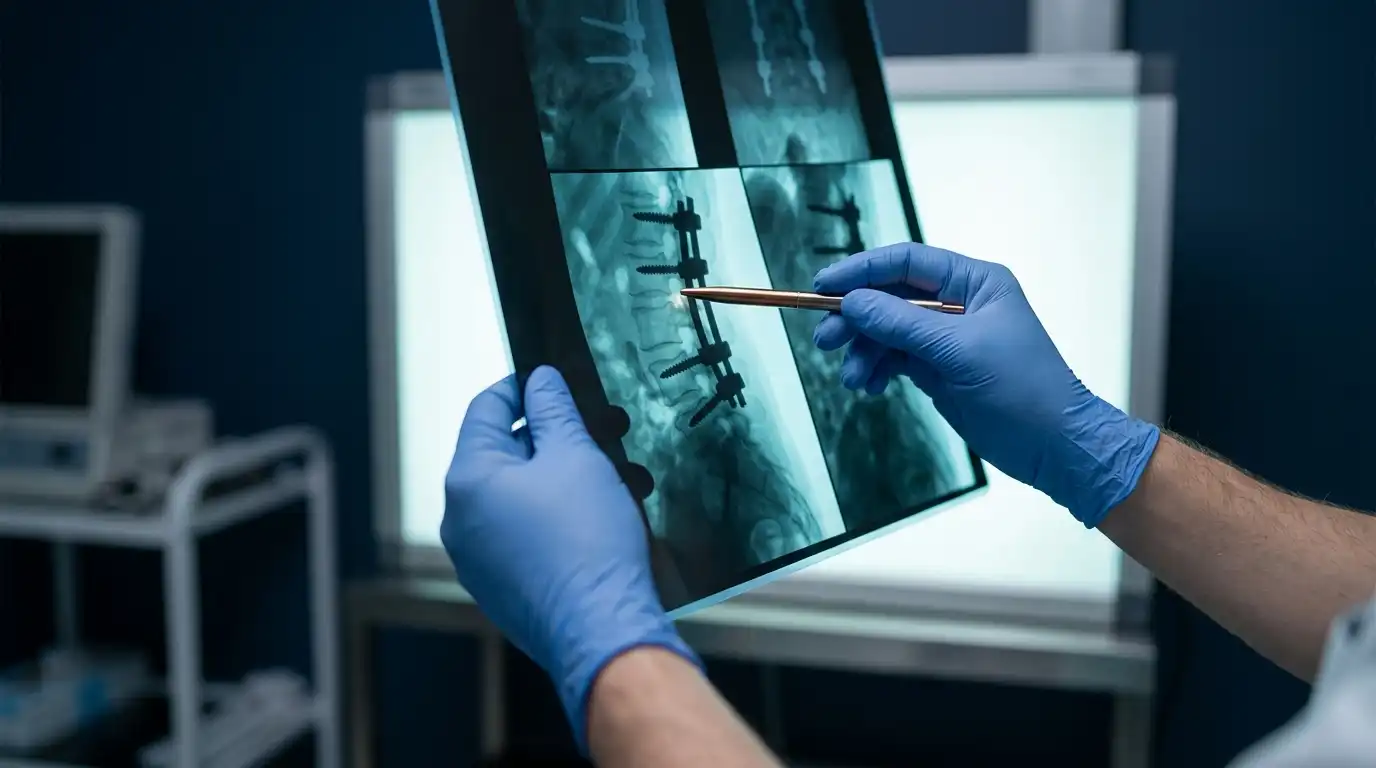
Revision spine surgery is not simply a repeat of the original procedure. Scar tissue (epidural fibrosis) obscures normal anatomy. Hardware may be embedded in bone or surrounded by reactive tissue. The neural elements may be sensitised. Fusion status must be assessed before any decision.
Success requires careful preoperative diagnosis - understanding exactly why the first surgery failed - before planning the revision. The wrong revision for the wrong reason produces the same outcome as the original failure.
Dr. Vignesh takes every revision case through a structured review process before recommending whether surgery is indicated, what type, and what realistic outcomes to expect.
Send us all prior surgical notes, implant records, and imaging before your consultation. We study the history so your appointment is used for examination and discussion - not re-gathering information.
CT with metal artifact reduction (MAR sequences) to assess hardware integrity and fusion. Dynamic flexion-extension X-rays to evaluate stability. MRI for neural element status and scar tissue mapping.
We explain what the original surgery achieved, what it didn't, and whether revision is likely to help. Some patients are better served by pain management than re-operation. We will tell you which category you fall into.
Revision surgery is planned with the same implant system where possible, or with a strategy to remove and replace hardware. Biological augmentation (BMP, bone graft) to improve fusion rates where prior fusion failed.
Longer operative times, higher blood loss, and more complex recovery than primary surgery - patients are counselled clearly. Intraoperative neuromonitoring throughout. Structured rehabilitation follows.
Levels above or below a fusion develop accelerated degeneration due to altered biomechanics.
Non-union is often missed on X-ray. CT is the definitive test; revision refreshes the fusion bed and rigidity.
Broken screws or rods indicate non-union. Replacing hardware without addressing fusion biology will fail again.
Loss of lumbar lordosis after fusion causes debilitating forward stooping. PSO or ACR restores sagittal balance.
Disc material re-herniates at the same level after successful initial discectomy. Re-discectomy with or without fusion.
Wound or deep implant infection requires debridement and washout, usually with hardware retention and antibiotics.
If you or a family member has undergone spine surgery and the outcome is unsatisfactory, or if you've been told you need revision surgery and want confirmation, a specialist second opinion is not disloyalty to your previous surgeon - it's good medicine.
We provide second opinions for patients from across India, including remote consultations where travel is not possible.
Working Days
Written opinion turnaround
Watch
Dr. Vignesh Pushparaj on the common, identifiable reasons a first spine surgery may not fully resolve symptoms - and how revision surgery is planned.
There is often an identifiable reason - and an appropriate solution. Let us review your case and give you a clear, honest assessment of your options.