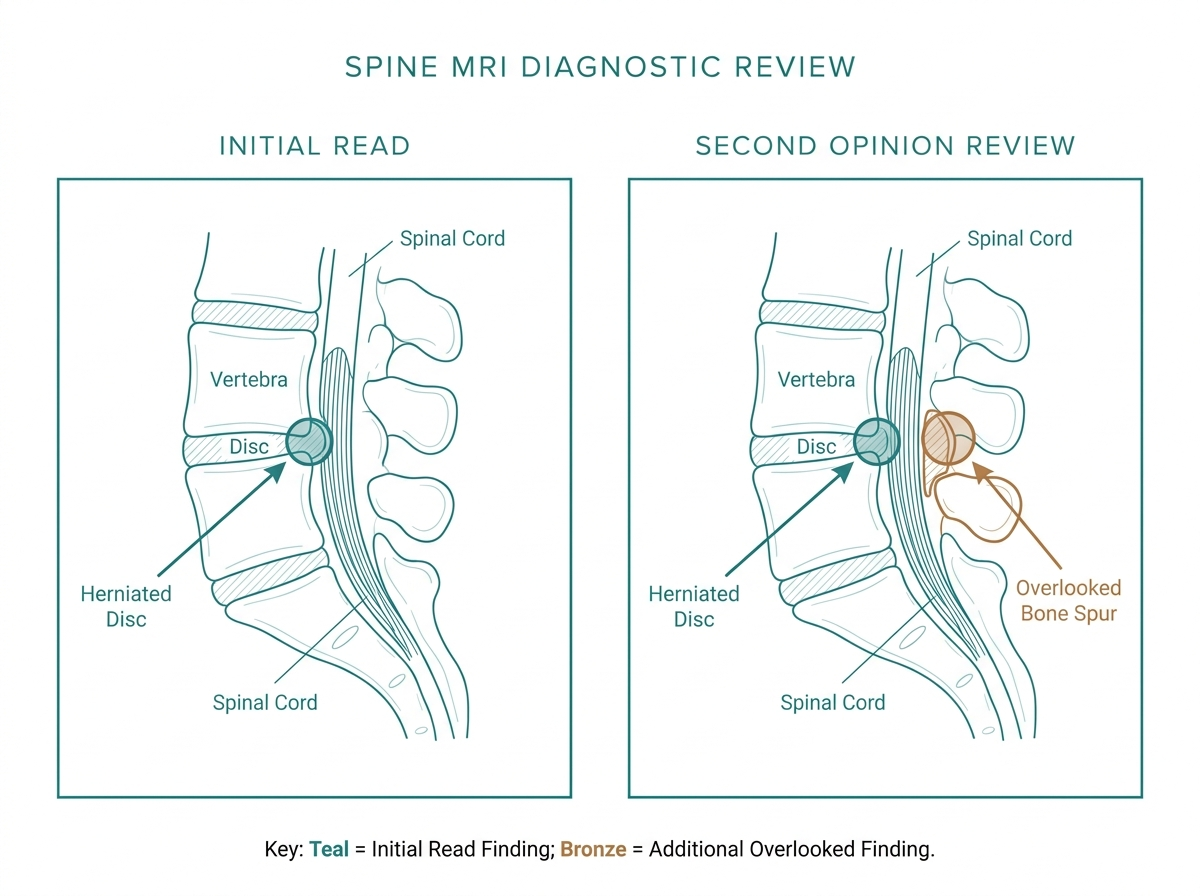
Warning Signs That Make a Second Opinion Essential
Certain situations move a second opinion from advisable to essential. If you recognise any of the following, seek an independent assessment before proceeding.
The Diagnosis Was Based on Imaging Alone
Imaging findings - disc bulges, degeneration, mild stenosis - are extremely common in adults and frequently do not correspond to the source of pain. A clinical diagnosis must correlate imaging with the specific pain pattern, clinical examination, and ideally confirmatory testing. Recommending surgery based on a scan finding without this correlation is insufficient. (Source: NIH/NLM - MedlinePlus, MRI and Low Back Pain)
The Proposed Surgery Does Not Clearly Match Your Symptoms
If you have difficulty understanding the connection between your pain and the proposed operation - or if the explanation given does not seem to logically follow from your experience - that uncertainty deserves resolution before you consent to surgery.
You Were Told Surgery Is the Only Option Without a Full Trial of Non-Surgical Care
For most spinal conditions other than true emergencies and progressive neurological deficits, non-surgical management should be thoroughly explored first. This includes targeted physiotherapy, injections, nerve pain medication, and activity modification. A recommendation for surgery before these have been systematically tried warrants scrutiny.
You Are Being Recommended Revision Surgery Without an Explanation of Why the First Operation Failed
This is particularly important. If you have had prior spine surgery and are being recommended another operation without a clear diagnostic explanation of what the first surgery failed to address - and what the revision will specifically correct - that is a significant red flag. Revision surgery requires a higher standard of pre-operative evaluation than primary surgery, not less.
You Feel Rushed or Dismissed
A good surgical consultation gives you time to ask questions and receive clear answers. If you feel your concerns were dismissed, your questions were not properly answered, or the consultation was very brief relative to the complexity of your condition, seek another perspective.
What to Bring to a Spine Second Opinion Consultation
The quality of a second opinion depends significantly on the quality of the information available to the consulting surgeon. A second opinion based on incomplete records is less reliable than one conducted with full access to your clinical history.
Bring the following when possible:
- All imaging on disc - MRI scans, CT scans, and X-rays. The actual images, not just the radiologist's report. The second opinion surgeon needs to review the images directly.
- Radiologist reports for all imaging studies
- The surgical recommendation letter or operative plan if surgery has been proposed
- Operative reports from any prior spine surgery
- Nerve conduction study results if available
- Blood test results relevant to your condition (inflammatory markers, bone health)
- A written summary of your symptoms - when pain started, where it is located, what makes it better or worse, how it has changed over time, and what treatments you have tried
- A list of current medications including any pain relief you are taking
If you are seeking a second opinion at MGM Malar - prior records including MRI images and operative reports are reviewed before the appointment so the consultation begins with full context rather than from zero.
The Right Questions to Ask in a Second Opinion
A second opinion consultation is your opportunity to get direct, clear answers to the questions that matter. Do not feel that any question is too basic or too challenging to ask.
Questions About Your Diagnosis
- "What exactly is causing my pain - and how confident are you in that specific source?"
- "Is this finding on my MRI the actual cause of my symptoms - or is it incidental?"
- "Are there other potential pain sources that have not yet been investigated?"
Questions About the Proposed Surgery
- "What specifically will this surgery correct?"
- "What is the expected outcome - and how is that outcome measured?"
- "What are the most realistic outcomes for someone with my specific case - not average outcomes?"
- "What are the risks of this procedure for me specifically, given my age, health, and the complexity of my spine?"
- "What happens if I don't have the surgery? What is the natural progression of my condition?"
Questions About Alternatives
- "Have all non-surgical options been appropriately explored for my condition?"
- "Is there a structured non-surgical programme you would recommend trying before surgery?"
- "Are there less invasive surgical alternatives to what has been proposed?"
Questions Specific to Revision Cases
- "Why do you believe my first surgery did not achieve the expected result?"
- "What will this revision surgery correct that the first surgery did not?"
- "What is the realistic expected outcome of revision surgery given my clinical picture?"
The Fundamental Test of a Good Second Opinion
At the end of the consultation, you should be able to answer three questions with clarity: What is actually causing my pain? What are my realistic options - surgical and non-surgical? What would you recommend, and why? If you cannot answer all three, the consultation has not done its job.
What a Good Second Opinion Actually Looks Like
A second opinion is not simply a scan review. It is an independent clinical assessment that encompasses the full picture of your case.
A thorough spine second opinion includes: a detailed review of all prior records and imaging before the consultation begins; a full clinical history - not just the current symptoms but the trajectory of pain over time, prior treatments, and their effects; a physical and neurological examination to assess nerve function, spinal movement, and specific provocation tests; an independent review of all imaging by the consulting surgeon (not just a reliance on the radiologist's report); a clear, plain-language explanation of findings; and a structured set of options with honest expected outcomes for each.
What it does not include: a quick scan review without examination; a recommendation that mirrors the first opinion without independent analysis; pressure to book a procedure at the end of the consultation; or vague reassurance that is not clinically grounded.
A second opinion that delivers genuine value is one where, regardless of whether the conclusion agrees or disagrees with the first assessment, you leave with a clear understanding of your situation and confidence in the decision you make next.
What If the Second Opinion Disagrees With the First?
This happens more often than most patients expect - and it is not a crisis. It is information.
If two experienced surgeons reach different conclusions about your case, it signals genuine clinical complexity or uncertainty. Both possibilities are important to understand:
Genuine complexity means your case does not have a clear single answer, and the right path forward may require further diagnostic workup - targeted injections, additional imaging, or a trial of non-surgical management - before a surgical decision can be made responsibly.
Genuine disagreement on interpretation means that the imaging, symptoms, or clinical picture is ambiguous enough that different experienced clinicians draw different conclusions. In this situation, the most conservative option that does not compromise your neurological safety is often the wisest starting point while further clarity is sought.
If two opinions disagree significantly, a third structured opinion is appropriate. You are not being indecisive. You are being appropriately careful about an irreversible intervention.
If two opinions agree on both the diagnosis and the proposed treatment independently arrived at - that is meaningful. Concordant independent opinions increase the confidence that the recommended path is correct.
Getting a Second Opinion Is Not Disloyalty
The most common reason patients delay seeking a second opinion is the belief that it will offend or betray the surgeon who has been managing their care.
This concern, while understandable, is misplaced. Any surgeon confident in their recommendation will actively support your right to seek independent verification. The standard of informed consent in elective surgery includes the expectation that you have had the opportunity to consider multiple perspectives.
If a surgeon discourages you from seeking a second opinion - explicitly or through creating guilt around the request - that itself is a clinical signal worth noting.
Medicine is not a loyalty transaction. Your spine, your neurological function, and your quality of life are the things that are at stake. You are entitled to be as sure as you reasonably can be before consenting to any significant intervention.
Second opinion consultations for patients who have been seen at other hospitals or clinics - in Chennai or anywhere in India - are a formal and structured part of this practice. You do not need to explain or justify the request. It is expected and welcome.
If you are living with persistent spinal pain and haven't had a formal structured evaluation yet, that is also where to begin. And if a prior surgery hasn't delivered the relief you were promised, the revision surgery evaluation process is built to give you honest answers about what can realistically be done.
Frequently Asked Questions About Spine Second Opinions
When should I get a second opinion for spine surgery?
You should seek a second opinion if you have been recommended surgery for a spinal condition - particularly spinal fusion, multi-level surgery, or revision surgery. Also seek one if you have had prior spine surgery with persistent pain, if different doctors have given you conflicting advice, or if your symptoms do not clearly align with the diagnosis you have received. A second opinion is your clinical right and is advisable for all significant elective spine procedures.
Is it normal to get a second opinion before spine surgery?
Completely normal - and advisable. Second opinions before elective spine surgery are standard practice in well-informed healthcare decision-making. They protect against unnecessary surgery, ensure that non-surgical options have been properly considered, and give you confidence that the recommended procedure is right for your specific case. Any surgeon who is confident in their assessment will support this.
Will my doctor be offended if I ask for a second opinion?
Any clinician confident in their recommendation will support your right to independent verification. A second opinion is not an accusation of error - it is a standard step in informed consent for significant elective procedures. If a surgeon actively discourages you from seeking one, that is itself informative.
What should I bring to a spine second opinion consultation?
Bring all available MRI and CT images on disc (not just the reports), X-rays, any surgical recommendation letter, operative reports from prior surgeries if applicable, nerve conduction study results, and a written summary of your symptoms - including timeline, location, aggravating and relieving factors, and all treatments tried. The more complete the clinical picture, the more useful the second opinion.
Can I get a spine second opinion if I live outside Chennai?
Yes. Second opinion consultations are available for patients from across India at MGM Malar, Chennai. Prior records including MRI scans and operative reports are reviewed before the appointment so the consultation is immediately productive. For patients travelling from a distance, the consultation is structured to be thorough and complete in a single visit.
How long does a spine second opinion take?
A proper second opinion is not a brief encounter. Records review occurs before the appointment. The consultation itself - clinical history, imaging review, physical examination, and plain-language explanation of findings and options - typically takes 30 to 45 minutes. You should leave with clarity about your diagnosis and your options, not with more questions than you arrived with.
One Question Worth Asking
Before any significant spine surgery, one question is worth sitting with: "Am I certain that this is the right procedure for the right reason - and has every other option been genuinely explored?"
If the answer is yes, you can proceed with confidence. If there is any uncertainty, a second opinion gives you the information to resolve it - one way or another.
The second opinion is not the end of the process. It is part of making a decision you can stand behind, whatever that decision turns out to be.
You are not obligated to get surgery simply because it has been recommended. You are not obligated to suffer through pain simply because someone told you nothing more can be done. And you are not obligated to carry the uncertainty of an important medical decision without getting the clearest possible picture first.
That clarity is what a good second opinion provides.