
A 42-year-old schoolteacher came to see me convinced that surgery was inevitable. She had months of back pain and a worrying-sounding MRI report in hand, and everyone she had spoken to - colleagues, family, an online forum at 1am - seemed to assume an operation was next.
Her examination did not match that assumption. There was no weakness, no red flags, and her pain, while real and limiting, followed a pattern that responds well to conservative care. She had also never had a properly structured physiotherapy programme - just a handful of unsupervised sessions months earlier that she had given up on.
Six weeks of a properly structured physiotherapy programme, one image-guided injection to calm an inflamed nerve root, and some changes to how she sat and lifted at work later, she was back in her classroom, pain-free.
Surgery is a powerful tool when it is genuinely needed. But as a spine surgeon, I spend far more of my time guiding patients through non-surgical options that work - and helping them understand which combination is right for their specific problem. This article explains what those options are, how they are chosen, and when they are enough.
What This Article Covers
- Why Conservative Treatment Comes First
- Physiotherapy: The Foundation of Recovery
- Medication: What It Can and Cannot Do
- Injections: Epidurals and Nerve Root Blocks
- Activity Modification and Lifestyle Changes
- Matching Treatment to the Diagnosis
- Non-Surgical Options for Long-Standing Pain
- When Conservative Treatment Isn't Working
- What a Non-Surgical Treatment Plan Actually Looks Like
- Frequently Asked Questions
Why Conservative Treatment Comes First
Surgery changes anatomy permanently. Because of that, it is reserved for situations where the benefit clearly outweighs the risk - typically when there is significant nerve compression causing progressive problems, or when conservative treatment has been tried properly and hasn't worked.
For the majority of back and neck pain, the body has a real capacity to heal with the right support. Inflammation settles, small disc fragments are reabsorbed, and supporting muscles regain the strength to take pressure off irritated structures. Non-surgical treatment is not a lesser option chosen for cost or convenience - for most patients, it is genuinely the correct clinical starting point, and it works. (Source: NIH - National Center for Complementary and Integrative Health)
Physiotherapy: The Foundation of Recovery
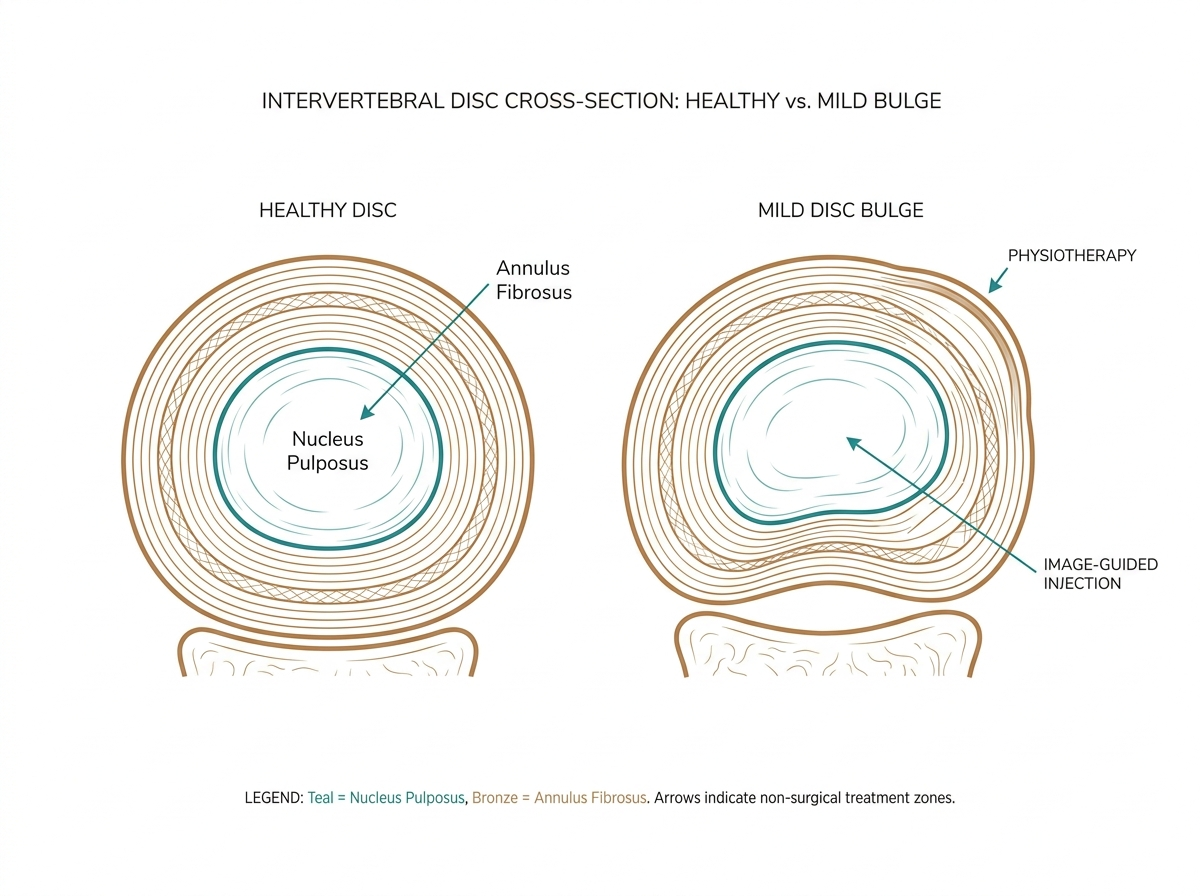
Physiotherapy is usually the backbone of any non-surgical back pain plan. It isn't simply about stretching - a good programme addresses the specific mechanical issues contributing to your pain, and it looks different for a disc-related nerve pain than it does for pure muscular strain.
Core and Postural Strengthening
Weak core and back-supporting muscles are a common contributor to recurring pain. Targeted strengthening helps the spine handle daily loads with less strain, and it is one of the few interventions with genuine long-term protective value against recurrence.
Mobility and Flexibility Work
Stiffness in the hips, thoracic spine, or hamstrings often shifts extra load onto the lower back to compensate. Addressing that mobility, not just the painful area itself, can meaningfully reduce pain and prevent it recurring.
Nerve Gliding and Specific Techniques
For patients with nerve-related pain radiating down an arm or leg, specific nerve mobility techniques, alongside general strengthening, are often part of the programme - these gently restore the nerve's ability to move within its surrounding tissue rather than being tethered by inflammation or scar tissue.
Key Takeaway
A generic set of exercises found online is not the same as a physiotherapy programme designed around your specific diagnosis. Supervised, structured programmes with clear progression consistently outperform unsupervised ones - the difference is not effort, it is direction.
Medication: What It Can and Cannot Do
Medication plays a supporting role, not a curing one. Anti-inflammatory medication can reduce swelling around an irritated nerve or joint, muscle relaxants can ease acute spasm, and nerve-pain-specific medications can help with radiating, burning pain that does not respond well to standard painkillers.
What medication generally cannot do is fix the underlying mechanical problem - that is the job of physiotherapy, injections where appropriate, or, when necessary, surgery. Medication is most useful as a short-term bridge that makes it possible to participate actively in physiotherapy, rather than a long-term standalone plan. Leaning on medication indefinitely without addressing the underlying cause tends to mask a problem rather than resolve it.
Injections: Epidurals and Nerve Root Blocks
For patients with significant nerve-related pain that isn't responding quickly enough to physiotherapy and medication alone, image-guided injections can be a valuable next step before considering surgery.
How They Work
Using imaging guidance - fluoroscopy or ultrasound - a small, precise dose of anti-inflammatory medication is placed directly around the irritated nerve root or into the epidural space, targeting the source of inflammation rather than relying on medication travelling through the whole body to reach it. (Source: NIH/NLM - MedlinePlus, Epidural Injections for Back Pain)
What They Can Achieve
For many patients, this significantly reduces pain and inflammation, often enough to allow physiotherapy to progress more effectively and, in a good number of cases, avoids the need for surgery altogether. Relief varies from patient to patient and is not always permanent, but it can provide a meaningful window for the underlying problem to genuinely heal rather than simply masking symptoms temporarily.
Who These Are (and Aren't) For
Injections work best when there is a clear, correlating source of nerve irritation to target. They are not a routine step for every patient with back pain - they are used selectively, based on the specific diagnosis, and are not a substitute for physiotherapy but a complement to it.
Activity Modification and Lifestyle Changes
A significant portion of recurring back pain is linked to daily habits - how you sit, lift, sleep, and move through the day. Simple, practical changes often make a real difference alongside formal treatment, and they matter as much for preventing recurrence as for resolving the current episode.
- Correcting workstation ergonomics, especially for long desk hours
- Learning safe lifting mechanics rather than bending from the back
- Building in regular movement breaks rather than prolonged static postures
- Addressing sleep position and mattress support where relevant
- Gradual weight management where excess load is contributing to spinal stress
None of these changes alone will resolve significant nerve compression, but combined with physiotherapy and, where needed, injections, they form the difference between a treatment that works temporarily and one that holds.