
Spine Health - Patient Education

When Do You Actually Need Spine Surgery?
A Surgeon's Decision Framework

"Doctor, the scan says I have a slipped disc. Do I need an operation?" It's one of the most common questions I hear - and the honest answer depends on more than the scan. Here is the actual framework surgeons use to decide.

By Dr. Vignesh Pushparaj · Complex Spine Surgeon, MGM Malar, Chennai · July 2026
Deciding whether spine surgery is necessary - surgeon's decision framework illustration, Chennai
14+ YearsEvaluating Spine Surgery Candidates
Conservative FirstSurgery Only When Genuinely Indicated
Structured TrialClear Timelines, Not Indefinite Waiting
Honest AssessmentNot Every Case Needs an Operation

A 34-year-old software engineer came to see me holding an MRI report he had already read cover to cover, twice. He had circled the word "herniation" in red pen. He had also, by his own admission, spent three nights reading about spine surgery on the internet and had convinced himself he needed an operation within the month.

His examination told a different story. His pain was real, but his strength was normal, his reflexes were normal, and his straight-leg raise test was only mildly positive. He had never actually tried a structured course of physiotherapy - he had gone straight from a scan to searching for a surgeon.

Six weeks later, after a proper physiotherapy programme and one consultation to explain what his scan actually meant in the context of his body, he was back at his desk, pain-free, with no operation.

I share this story often because it captures something patients rarely hear plainly: an MRI report is not a prescription for surgery. It is one piece of a larger picture. This article walks through the actual framework spine surgeons use to decide whether surgery is necessary, so you can understand where you stand and ask the right questions at your next appointment.

What This Article Covers

  1. The MRI Myth: Why a Scan Alone Never Decides Surgery
  2. Red Flags: Symptoms That Mean You Should Not Wait
  3. The Conservative Treatment Window
  4. The Surgeon's Decision Framework
  5. How This Plays Out: Lumbar Disc Herniation and Stenosis
  6. How This Plays Out: Cervical Conditions and Deformity
  7. When a Second Opinion Makes Sense
  8. If Surgery Is Needed: What Are the Options
  9. What a Proper Surgical Decision Consultation Looks Like
  10. Frequently Asked Questions

The MRI Myth: Why a Scan Alone Never Decides Surgery

One of the most persistent misunderstandings I encounter in clinic is the belief that an MRI report is a verdict - that if a word like "herniation," "bulge," or "degeneration" appears on the page, surgery must follow. It doesn't work that way, and the evidence on this is fairly clear.

Studies on people with no back pain at all have repeatedly found disc bulges, degenerative changes, and even outright herniations on their scans. Some of the most striking imaging findings turn up in people who have never had a day of back pain in their life. An abnormal-looking MRI does not automatically mean you are in danger, and it does not automatically mean you need an operation. (Source: NIH/NLM - MedlinePlus, MRI and Low Back Pain)

What an MRI shows is structure - where a disc is bulging, whether a nerve root looks compressed, whether there is instability between vertebrae. What it cannot tell us on its own is how much that structural finding is actually contributing to your pain, or how your body will respond to treatment. That correlation between imaging and clinical picture - matching what the scan shows to what you are actually feeling and how you examine on the table - is where surgical judgment comes in, and it is not something a radiology report can do by itself.

The Core Principle

  • A scan is one input into the decision, not the decision itself
  • Many abnormal findings on MRI are incidental and not the source of pain
  • Surgery is recommended based on symptoms, examination, and response to treatment
  • The scan is used to confirm and plan a treatment - not to trigger surgery by itself

Red Flags: Symptoms That Mean You Should Not Wait

While most back and neck pain can be safely observed and treated conservatively for a period of time, certain symptoms change the calculation entirely. These are called "red flags" in spine medicine because they suggest a real risk of permanent nerve or spinal cord damage if surgery is delayed. (Source: NIH/NLM - MedlinePlus, MRI and Low Back Pain)

  • Progressive weakness in an arm or leg - not just pain, but actual loss of strength that is getting worse over days
  • New difficulty controlling the bladder or bowels
  • Numbness in the saddle area (inner thighs, groin, area you would sit on) - a possible sign of cauda equina syndrome, a genuine surgical emergency
  • Fever, unexplained weight loss, or a history of cancer combined with new back pain
  • Severe, worsening pain that does not improve with rest or a change in position
  • Pain following significant trauma, especially in someone with osteoporosis or on long-term steroids

If you notice any of these symptoms, this is not the time for a "wait and see" approach, and it is not the time to schedule a routine appointment for a few weeks out. Seek evaluation the same day, ideally at a facility that can arrange urgent imaging if needed.

To be clear about proportion: the overwhelming majority of patients who walk into a spine clinic do not have red flags. Most have pain without neurological compromise, and for them, the next section is the one that matters.
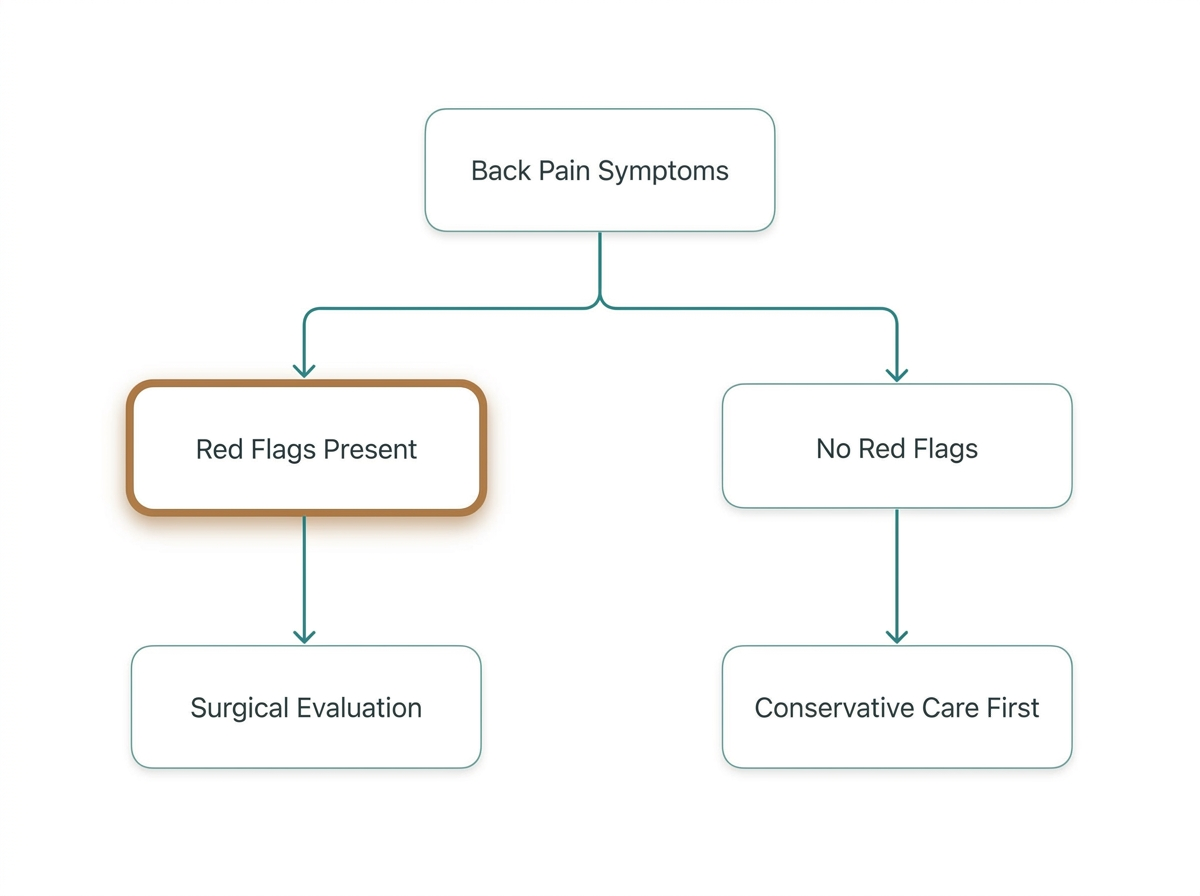
Decision-tree flowchart showing how red flag symptoms lead to surgical evaluation, while their absence leads to conservative care first
The framework in simple terms: red flags point toward surgical evaluation; their absence points toward conservative care first.

The Conservative Treatment Window

For patients without red flags, conservative treatment is almost always the appropriate starting point. This typically includes a combination of structured physiotherapy, targeted exercise, short-term medication for inflammation and pain, activity modification, and - for select patients - image-guided injections.

How Long Is Reasonable?

A commonly used window is 6 to 12 weeks of structured, supervised conservative treatment. "Structured" is the operative word here - three months of lying in bed hoping for the best is not the same as an active physiotherapy programme with clear milestones, a home exercise plan, and periodic reassessment. If you are genuinely improving within this window, that trend usually continues with continued conservative care, and there is rarely a reason to interrupt it with surgery. If there is no meaningful improvement, or symptoms are worsening despite good compliance with the programme, that is the signal to revisit the surgical option.

Why the Window Matters Both Ways

Rushing to surgery before giving conservative treatment a fair trial can expose a patient to the risks, cost, and recovery time of an operation they may not have needed at all. But an indefinite, unstructured "wait and watch" approach for a patient who is genuinely not improving can allow a treatable problem to become a harder one - nerve irritation that could have resolved with timely treatment can, in some cases, progress to more established damage. Both extremes are avoidable with regular, honest reassessment rather than either impulsive surgery or open-ended waiting.

What "Structured" Actually Looks Like

A structured conservative programme has a starting assessment, specific goals, a defined review point, and someone - usually the treating physiotherapist together with the referring physician - tracking whether those goals are being met. If a patient comes back at week six with no clear record of what was tried, how consistently, and what changed, that is not really a structured trial. It is simply time passing.

Dr. Vignesh Explains: Do You Actually Need Spine Surgery?

Dr. Vignesh Pushparaj on the decision framework surgeons actually use before recommending surgery.

The Surgeon's Decision Framework

When deciding whether to recommend surgery, several factors are weighed together - not looked at in isolation. This is the mental checklist that actually runs behind the scenes of a surgical recommendation.

Nature and Severity of Symptoms

Is this primarily pain, or is there measurable weakness, numbness, or reflex change on examination? Motor weakness - an inability to lift the foot, grip firmly, or push against resistance - generally carries more urgency than pain alone, because ongoing nerve compression causing weakness can, over time, become permanent.

Trajectory

Are symptoms stable, improving, or progressively worsening? A stable or improving picture supports continued conservative care. A clearly progressive one - where each week brings measurably less strength or more numbness - supports earlier intervention, even within what would normally be a conservative treatment window.

Correlation With Imaging

Does the compressed nerve level on the scan match the distribution of your symptoms? If your pain and numbness run down the outside of your left leg to the big toe, and your MRI shows compression at the corresponding nerve level on the left, that correlation strengthens the case for surgery when conservative treatment fails. A mismatch between symptoms and imaging is a reason to look further before concluding surgery is the answer.

Impact on Function and Quality of Life

Can you work, sleep, and carry out daily activities, or has the condition taken those away from you despite reasonable treatment? This is a legitimate and significant factor in the decision - not a secondary or "soft" consideration. Persistent, severe functional impairment despite an adequate conservative trial is itself a reasonable basis for surgery, even without red flags.

Patient Factors

Age, overall health, bone quality, occupation, and personal goals all shape what a reasonable recommendation looks like for a given individual. A professional athlete, a manual labourer, and a retired office worker with the same MRI finding may reasonably be offered different advice, because the calculation of risk, benefit, and urgency is genuinely different for each of them.

In Short

Surgery becomes the right call when there is a clear structural problem, it correlates with your symptoms, and conservative treatment has been given a fair, structured trial without adequate improvement - or when red flags make waiting unsafe in the first place.

How This Plays Out: Lumbar Disc Herniation and Stenosis

The framework above is a set of principles. In practice, how it plays out varies significantly by condition. Two of the most common lumbar presentations illustrate this well.

Lumbar Disc Herniation

Most lumbar disc herniations improve with conservative treatment within 6–12 weeks. This is partly because the body has a genuine ability to reabsorb herniated disc material over time, and partly because inflammation around the nerve - often the larger contributor to pain than the mechanical compression itself - settles with appropriate treatment. Surgery is considered when there is significant, symptom-correlating weakness, when cauda equina symptoms are present, or when persistent, disabling leg pain continues despite an adequate conservative trial. Learn more about disc herniation evaluation and treatment.

Spinal Stenosis

Spinal stenosis - narrowing of the spinal canal, often age-related - is frequently managed conservatively at first, particularly in older patients where surgical risk needs to be weighed carefully. However, surgery is more strongly considered when walking distance is severely and progressively limited, when there is measurable neurological deficit, or when the impact on daily independence has become significant despite conservative measures. Stenosis is a good example of a condition where "how much is this actually limiting you" often matters as much as the imaging severity. (Source: NIH/NLM - MedlinePlus, Spinal Stenosis)

How This Plays Out: Cervical Conditions and Deformity

Cervical Disc Disease and Radiculopathy

The same core principle applies in the neck - physiotherapy, medication, and activity modification first, with surgery reserved for progressive weakness, signs of spinal cord involvement (a more urgent picture called myelopathy), or genuine failure of a fair conservative trial. Cervical symptoms can be alarming because they often involve the arms and hands, but the decision framework does not change just because the location does.

Scoliosis and Spinal Deformity

Deformity is a different kind of decision. Here, the question is less often "does surgery help right now" and more often "is this curve progressing, and at what rate." Decisions depend heavily on curve progression over time, skeletal maturity in younger patients, and symptom burden, and typically involve monitoring at intervals rather than an immediate call at the first visit. A curve that is stable and causing minimal symptoms may simply be observed; one that is progressing steadily, or causing significant pain or functional limitation, moves toward surgical discussion. Learn more about scoliosis evaluation and treatment.

When a Second Opinion Makes Sense

If you have been told you need surgery and something about the recommendation feels rushed, or you simply want confirmation before proceeding, a second opinion is a reasonable and common step - not a sign of distrust toward your treating doctor.

It is particularly worth seeking if conservative treatment was never structured or given a proper trial, if the proposed surgery seems disproportionate to your actual symptoms, if the explanation you were given does not clearly connect your symptoms to the proposed procedure, or if you are being asked to decide urgently without any red flag symptoms present to justify that urgency.

Read more about when to get a second opinion before or after spine surgery.

If Surgery Is Needed: What Are the Options

When surgery is genuinely indicated, the next question is usually how it will be performed. Depending on the specific condition, its complexity, and your anatomy, minimally invasive or endoscopic approaches may be suitable, generally involving smaller incisions, less muscle disruption, and a shorter recovery compared to traditional open surgery.

More complex or revision cases - particularly where prior surgery, significant deformity, or multi-level involvement is present - may require open techniques to achieve a durable, lasting result. The right approach is determined case by case after a full evaluation of the anatomy and the specific problem being corrected. It is never a one-size-fits-all decision, and any surgeon who proposes a single approach without discussing why it fits your specific case is worth questioning further.

What a Proper Surgical Decision Consultation Looks Like

At the first consultation, we walk through your full history - not just your most recent scan, but how the pain started, what has changed, and what you have already tried. If you have completed a course of conservative treatment, we review in detail how you responded to it, not just whether you "got better" or "didn't."

A physical and neurological examination follows, testing strength, reflexes, and sensation in a way that a scan cannot replace. Your imaging is reviewed directly, in the context of your specific symptoms, rather than relying on the radiologist's report in isolation.

You leave with a clear explanation of where your case sits on this decision framework - a plain-language answer to "do I actually need surgery," and if the answer is not yet clear, a specific plan for what needs to happen before it can be.


Frequently Asked Questions About Spine Surgery Decisions

How long should I try conservative treatment before considering surgery?

For most non-emergency back and neck pain, 6 to 12 weeks of structured conservative treatment - physiotherapy, medication, and activity modification - is a reasonable trial before surgery is seriously discussed, provided there are no red flag symptoms.

What are the red flag symptoms that mean I should not wait?

Progressive weakness in a limb, loss of bladder or bowel control, numbness in the saddle area, fever with back pain, or pain that is worsening despite rest are red flags that warrant urgent evaluation rather than a prolonged conservative trial.

Does a disc bulge on MRI automatically mean I need surgery?

No. Disc bulges and even herniations are common on MRI, including in people with no pain at all. The decision for surgery is based on symptoms, examination findings, and how you respond to conservative care - not the scan alone.

Can physiotherapy alone fix a herniated disc?

Many disc herniations improve with physiotherapy, activity modification, and time, as the body naturally reabsorbs part of the herniated material. Physiotherapy works best when there is no significant nerve compression causing progressive deficits.

What happens if I delay surgery when it is genuinely needed?

Delaying surgery when there is genuine nerve compression with progressive weakness can lead to permanent nerve damage in some cases. This is why an accurate evaluation matters - to distinguish patients who can safely wait from those who cannot.

Is minimally invasive spine surgery an option if I do need surgery?

In many cases, yes. Depending on the condition and its complexity, minimally invasive or endoscopic techniques may be appropriate, generally offering smaller incisions and a shorter recovery than traditional open surgery. Suitability is assessed case by case.

How do I get a proper evaluation for back or neck pain in Chennai?

Start with a clinical examination and history from a spine specialist, who will decide if imaging is needed and interpret it in the context of your symptoms. Dr. Vignesh Pushparaj evaluates patients at MGM Malar, Chennai.

The Question Worth Asking

An MRI report on its own cannot tell you whether you need surgery. Neither can a single opinion delivered in five minutes without a proper examination and a genuine look at your history.

The question worth asking is not "does my scan look bad?" The question is: "Has anyone actually correlated my symptoms, my examination, and my response to treatment before recommending - or ruling out - surgery?"

You are not obligated to accept a recommendation for surgery simply because a scan contains an alarming word. You are also not obligated to wait indefinitely if your symptoms are genuinely progressing. Both extremes are avoidable with a proper evaluation.

That is where a sound decision begins - not with the scan, but with you.

Spine Surgery Decision Assessment - Chennai

Not Sure If You Need Surgery?

A structured evaluation is the first step. Full clinical history, physical examination, and independent review of your imaging. Honest assessment of your options - surgical and non-surgical.
Consultations available for patients across India.

Dr. Vignesh Pushparaj

Written By

Dr. Vignesh Pushparaj

MS Ortho · FNB Spine · AO Spine Fellow

Dr. Vignesh Pushparaj is a fellowship-trained complex spine surgeon at MGM Malar, Chennai, with 14+ years of experience evaluating both surgical and non-surgical spine conditions. He is committed to recommending surgery only when a structured evaluation genuinely supports it - and to saying so plainly when it doesn't.

View Full Profile